
See what your company's AI spend produced.
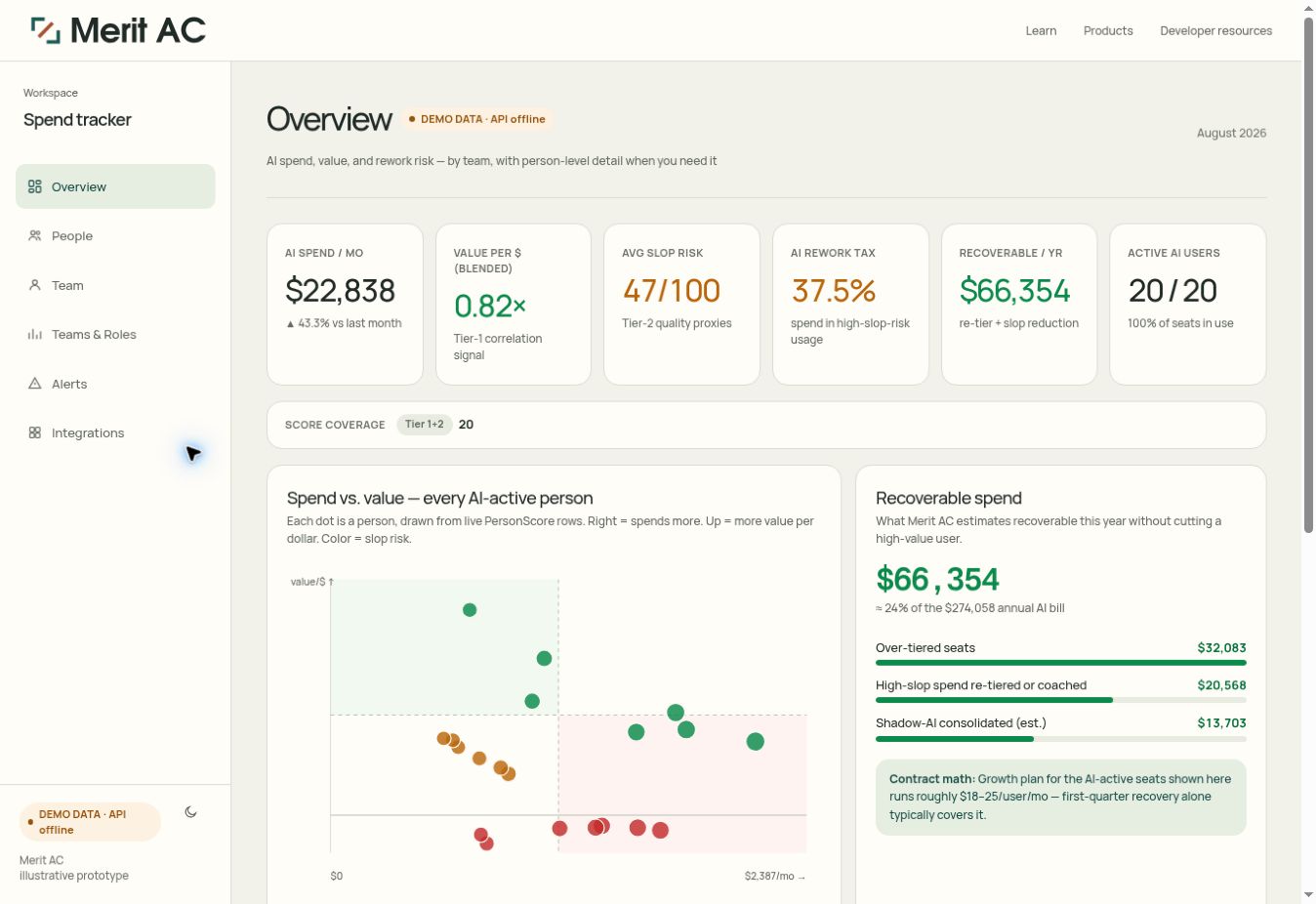
Most companies know what they spend on AI and nothing about what it bought. The Merit spend tracker tells you who's spending, on what, and whether it's turning into real work or slop — a nightly-updated dashboard of spend, value per dollar and rework risk, across every team.
What you get
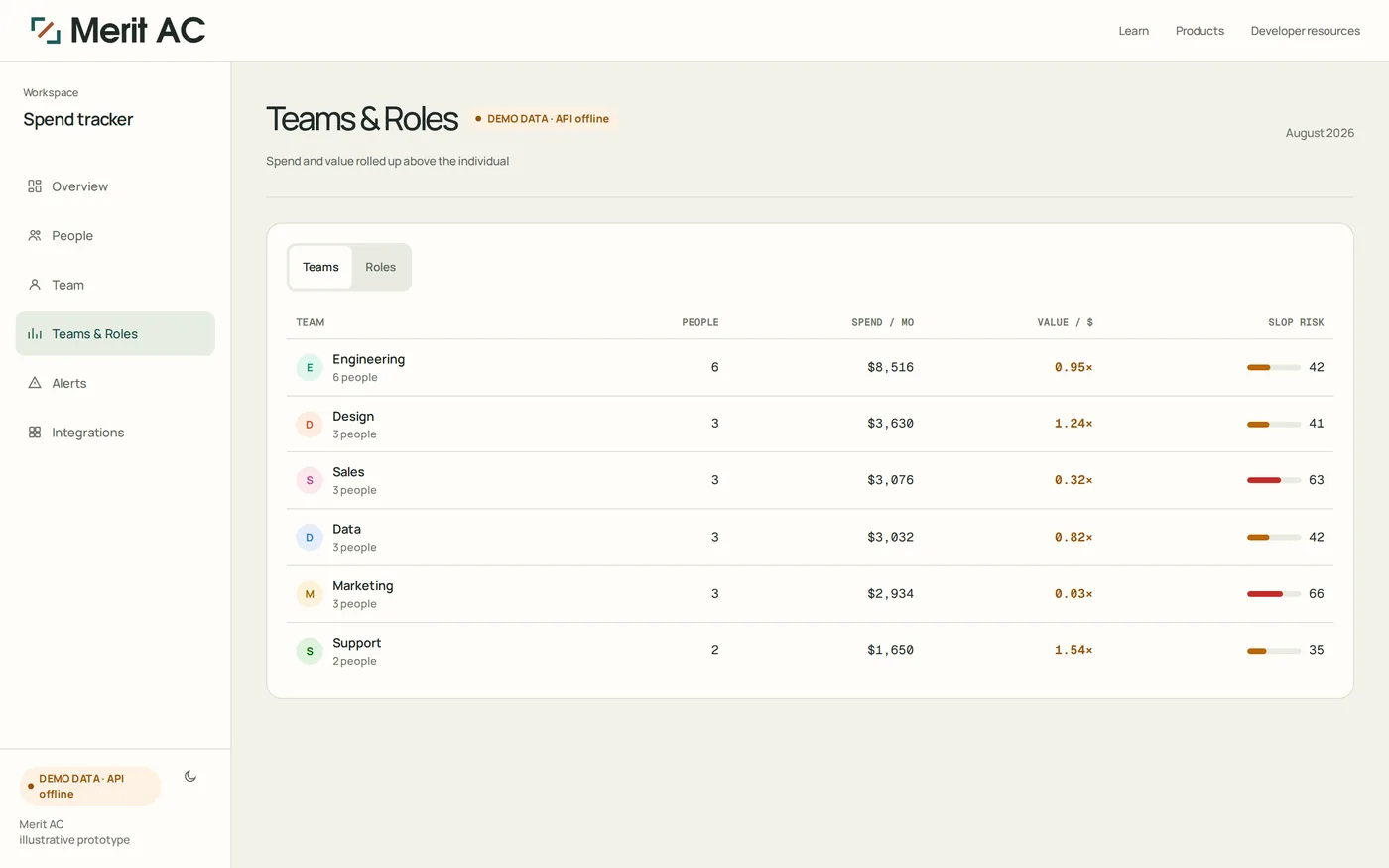
Spend, by team and person
The AI spend you send through your LLM proxy or billing export, rolled up by team and role, with person-level detail when you need to dig in.
Value per dollar, not just cost
Spend is set against the outcomes you send: merged and reverted PRs, tickets and deals, sent through the ingest API. The result is an estimate of value per dollar, not proof of productivity.
Rework and slop risk
A rework-risk score built from reverted code, merges with failing CI and any quality signals you send, so activity that looks busy but gets undone doesn't hide in the total.
Your own tools, nightly
Usage, outcome and quality events you send are scored by a nightly job, one row per person. Your tools post them to the ingest API. A GitHub sync exists but isn't switched on yet.

How it works
- Start your organization. Create your company's workspace — it's yours alone, isolated from every other.
- Connect your data. Point your LLM proxy or billing export at the ingest token; we help you wire it up.
- Read the dashboard. Spend, value per dollar and rework risk, updated nightly — invite your whole team in at no extra charge.

How the scores are calculated
Every number comes from three kinds of event you send, each tied to a person through an identity mapping you control. A nightly job turns one calendar month of events into one row per person. The formulas and default weights are below, as the code uses them today.
Observed: spend
The cost on each usage event from your LLM proxy or billing export, summed per person per month. This is measured, not estimated, but only covers usage you send.
Estimated: value per dollar
Outcome events are weighted (merged PR +3, reverted PR −4, ticket resolved +1, ticket reopened −2, deal stage advanced +2.5, doc published +1.5), summed and divided by spend, then shown as a multiple of your company's median. It shows correlation, not cause.
Estimated: rework risk
A 0 to 100 score from quality signals such as reverted code or a merge with failing CI: the average severity, scaled up as signals accumulate, capped so five reverts don't read as five times worse than one.
When data is missing
- Someone with no AI spend that month isn't scored at all.
- Someone with spend but no outcome events scores 0× the median. That can mean their work isn't reaching the tracker, not that it has no value.
- Someone with no quality signals gets a rework risk of 0 and a lower confidence label (outcomes only), not a clean bill of health.
- Usage from an account nobody has mapped to a person is refused and listed as possible shadow AI for an admin to map, rather than counted against someone.
What the scores can't tell you
A merged PR, a closed ticket or a person's multiple doesn't prove that person was productive or that AI caused the result. The weights are defaults, not calibrated to your business, until you grade a sample of real output and the third tier recalibrates them for your organization. The recoverable-spend figure on the overview is a rough estimate from fixed percentages. Use the numbers to decide where to look, not to rank or judge people. The scores are confidence-tiered signals, not measures, and for a high-spend, high-slop person the recommendation is to coach and re-tier, never to cut.
Product facts
- Who it's for
- Finance and engineering leads at companies whose AI spend is spread across teams and tools.
- What it does for you
- A monthly view of who spends what on AI, an estimate of what that spend produced, and where output keeps getting undone.
- What runs, and where
- A hosted web app run by Merit AC: the API on Fly.io (US East), the dashboard in your browser. Your team signs in to see it.
- AI model
- None. Scores are the fixed formulas above; the spend forecast is a ridge regression, not a language model.
- What you need
- Someone who can point your LLM proxy or billing export at the ingest API, and map each account to a person
- For outcomes: your own integration posting merged and reverted PRs, tickets, deals and docs to the ingest API
- The Python and Node setup guides show the ingest call, the fields Merit AC expects, mapping identities before you ingest, and how to check that it worked
- You provide
- Usage events (who, which tool and model, cost), outcome events and quality signals.
- You get back
- Dashboards by person, team and role: spend, value per dollar, rework risk, a confidence label, recommendations and a spend forecast.
- Price and billing
- $99/mo for your whole organization, however many teammates you invite. Month to month, cancel any time.
- Delivery
- Create your organization, then subscribe from its billing card. It's active as soon as Stripe confirms payment.
- Support and updates
- Email. Setup help for connecting your data is included.
- Known limits
- Early release: not yet suited to sensitive or regulated data.
- People come from Okta or Microsoft Entra over SCIM, or an admin adds them by hand. Other identity providers use the manual route.
- No ready-made outcome connectors are switched on yet. Outcomes have to be sent through the API.
- Scores update nightly, not live.
- Value per dollar and rework risk are estimates for deciding where to look, not measures of a person's performance.
Start your organization
$99/mo covers your whole company, however many teammates you invite — it isn't priced per seat. Month to month, cancel any time.
Subscribe · $99/moWant to shape it before you buy? Become a design partner. Design partners pay the same $99/mo, month to month. You connect your real AI spend data and give Andrew a 30-minute call once a month on what the numbers got right and wrong. In return, Andrew helps you connect your data and your feedback decides what gets built next.